




Does Sustainable Packaging Cost More Than Conventional Packaging?
Does Sustainable Packaging Cost More Than Conventional Packaging?
Does sustainable packaging cost more than conventional packaging? In many purchase orders, the short answer is yes: the unit price of a recycled-content resin, compostable film, molded fiber tray, or redesigned lightweight pack can be higher than a familiar virgin-plastic alternative. But that answer is incomplete, and sometimes badly misleading.
Packaging cost is not just the price shown by a converter. It also includes scrap, line speed, tooling changes, damage in transit, packaging taxes or extended producer responsibility fees where applicable, warehouse efficiency, and the risk of using a material that does not fit the collection system in the market where it is sold. A cheaper pack that causes sealing failures, weakens product protection, or creates a compliance problem is not truly cheap.
For manufacturers, the useful question is not “Which material is greener?” It is: what is the lowest total-cost packaging system that meets product protection, processing, regulatory, and end-of-life requirements? That distinction matters whether the pack is an injection-molded cap, an extruded barrier film, a thermoformed food tray, or a die-cast reusable transport component.
Why the Upfront Price Often Looks Higher
Sustainable packaging is not one material category. It can mean recycled-content polyethylene or polypropylene, recycled PET, paper-based structures, mono-material flexible packaging, reusable formats, bio-based polymers, compostable materials, or simply a package redesigned to use less material. Each has a different cost profile.
Recycled polymers can cost more than virgin grades when high-quality feedstock is limited, when color consistency matters, or when the application requires tight control of odor, contamination, melt flow, impact strength, or food-contact status. A molded part may run acceptably with one recycled grade but become unstable with another. The processor then pays through higher rejection rates, longer changeovers, more frequent cleaning, or reduced cycle consistency. The material price is only the beginning of the calculation.
Compostable and bio-based materials introduce a different set of trade-offs. Some require narrower processing windows than conventional resins. Moisture handling, drying discipline, melt-temperature control, residence time, and mold temperature can all matter. In extrusion, a film that looks promising in a lab trial may not maintain gauge control or seal performance at commercial line speeds without process adjustments. In injection molding, a material may require altered barrel settings or more careful management of regrind. Those operational changes can add cost even before the package reaches the customer.
Paper and molded fiber solutions may appear straightforward, but they can demand new forming tools, protective coatings, secondary packaging changes, or redesigned pallet patterns. They are often excellent choices for certain dry goods, electronics inserts, and food-service applications. They are not automatically the lower-cost answer for products exposed to moisture, grease, long shipping routes, or high compression loads.
Scale is another blunt reality. Conventional packaging formats benefit from mature tooling, established supply chains, familiar quality-control routines, and large production volumes. A sustainable alternative made in smaller lots may carry higher conversion and logistics costs simply because the system around it is less developed.
The Cost Comparison Should Move Beyond Price per Piece
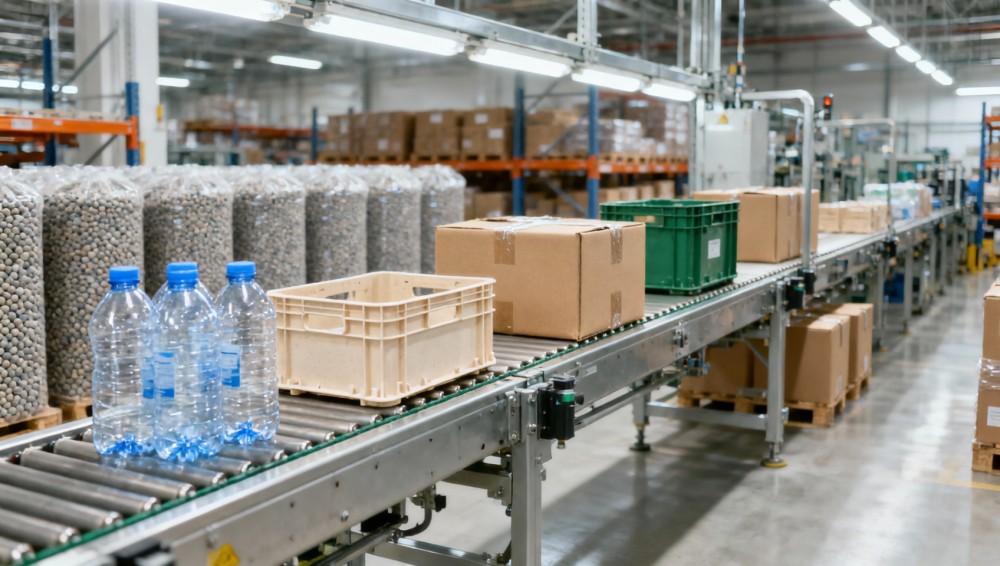
A sensible comparison starts with a functional unit: one package that protects a defined product for a defined journey. Comparing the resin cost per kilogram is useful for procurement, but it does not settle the packaging decision. A lighter package can cost more per kilogram and less per shipped unit. A reusable crate can have a high purchase price but become economical over repeated circulation—provided return logistics are real rather than assumed.
The practical implication is simple: a packaging buyer should compare landed cost and total system cost, not invoice price alone. This is especially important for high-volume molded packaging, where a few seconds of additional cycle time or a small increase in reject rate can quickly outweigh a modest material saving.
Where Sustainable Packaging Can Actually Reduce Cost
The strongest cost cases often come from redesign, not from replacing one expensive “eco material” with another. Lightweighting is the obvious example. If a bottle, closure, tray, or protective component can use less material while maintaining stiffness, top-load performance, seal integrity, and handling safety, the business case can be more direct than switching materials altogether. However, lightweighting should be validated against real filling, stacking, transport, and consumer-use conditions. A thinner wall that buckles after pallet compression simply shifts the cost into product loss and claims.
Mono-material design can also reduce complexity. A package made from fewer incompatible layers or components may be easier to sort and recycle, while potentially simplifying sourcing and assembly. Yet mono-material structures are not always suitable for demanding barrier applications. Oxygen, water vapor, aroma, light exposure, and chemical resistance need to be tested against the actual shelf-life requirement. Recyclability does not compensate for spoiled product.
In durable industrial packaging, reuse can be attractive when the circulation loop is controlled. Automotive suppliers, appliance manufacturers, and component distributors may use returnable trays, racks, or pallets because the assets move repeatedly between known locations. The economics weaken when containers are lost, returned empty over long distances, or managed without reliable tracking. Reuse is a logistics model before it is a material choice.
There can also be a cost of doing nothing. Packaging rules differ by market and continue to evolve. Businesses selling across borders should not assume that a design acceptable in one region will carry the same labeling, material, or producer-responsibility implications elsewhere. The relevant obligation depends on the product category, market, packaging composition, and local implementation. Early review is generally far less expensive than a late redesign caused by a rejected specification or an unexpected fee structure.
Processing Reality: The Factory Floor Decides the Outcome
Packaging conversations often become too focused on material declarations and not focused enough on manufacturability. For polymer processors, material rheology is not an abstract technical issue. It determines filling behavior, weld-line strength, shrinkage, warpage, surface finish, and the stability of the entire production window.
Consider a recycled-content injection-molded closure. The resin may meet a target recycled percentage, but variations in melt flow can affect filling and dimensional consistency. If the closure depends on precise thread geometry, torque performance, or a tamper-evident band, the molder needs to verify more than appearance. The same applies to extruded film: a change in resin or structure can influence drawdown behavior, sealing, puncture resistance, and machine-direction performance.
This is why material trials should not stop at producing acceptable first samples. A useful trial plan observes scrap patterns, cycle stability, energy use, maintenance demands, downstream packing behavior, and performance after realistic storage or transport exposure. A material that behaves well for an hour may be troublesome across a full production shift. That is an expensive lesson if discovered after a nationwide launch.
For technical teams monitoring these shifts, intelligence platforms such as GPM-Matrix are useful not because they offer a universal answer, but because they connect material behavior with the equipment and market conditions surrounding it. Recycled-material processing, biodegradable polymer handling, IIoT-based maintenance, and lightweighting all intersect at the factory floor. A sustainability target that ignores the molding machine, extrusion line, die condition, or quality-control capability is usually just a purchasing target.
How to Build a Better Cost Decision
Start by defining what the package must do. Protecting sterile medical packaging, shipping a detergent refill, presenting cosmetics at retail, and moving metal components between plants are very different tasks. The required barrier, mechanical strength, appearance, traceability, and end-of-life route should be written down before materials are shortlisted.
Then map the current package honestly. Record material weight, component count, manufacturing scrap, line speed, damage rates, secondary packaging, transport configuration, and likely disposal route. If these baseline figures are missing, a “sustainable” alternative cannot be evaluated properly. Teams often discover that the most promising improvement lies in an overlooked component: a label, closure, pigment, adhesive, multilayer insert, or unnecessarily oversized shipping case.
Shortlist alternatives by application fit rather than by marketing language. Ask suppliers what percentage of recycled content is technically realistic for the intended process, what property variation should be expected, whether the grade is appropriate for the contact conditions, and what processing changes may be required. For compostable materials, ask which disposal conditions are necessary and whether those conditions exist in the intended markets. “Compostable” without a credible collection and treatment route may create consumer confusion rather than a circular outcome.
Finally, run a controlled comparison that includes production and post-production performance. Procurement should be involved, but so should quality, operations, logistics, regulatory, and product teams. A packaging decision made by a single department tends to optimize one line item while creating trouble somewhere else.
The More Useful Answer
Sustainable packaging can cost more than conventional packaging at the point of purchase, particularly when material supply is constrained, processing requires adjustment, or volumes are low. It can also cost less over its working life when it reduces material use, improves transport efficiency, avoids unnecessary complexity, fits a controlled reuse system, or lowers exposure to changing waste and compliance costs.
The better decision is rarely made by choosing the cheapest resin or the boldest environmental claim. It comes from matching material, process, product protection, and recovery route with clear-eyed attention to what happens before and after the package leaves the molding or converting line. In packaging, circularity is only credible when the design works in the real supply chain.
Related News
- 00
0000-00
How giga-casting innovations are improving aluminum part design - 00
0000-00
How to choose a laboratory rubber mixing mill for small-batch compounds - 00
0000-00
Technical comparison guide for choosing all-electric molding machines - 00
0000-00
How to verify compliance with plastics carbon standards - 00
0000-00
How evolutionary trends in automation are reshaping manufacturing investment