


Injection Molding Pricing: How Tooling, Resin, and Volume Shape Part Costs
A low injection molding unit price is not necessarily a low-cost offer. One supplier may charge separately for the mold, while another recovers tooling investment through each shipment. Resin grade, order size, inspection requirements, and freight assumptions can widen the difference further. Quotes become comparable only when they cover the same part specification, delivery conditions, and credible production volume.
The central decision is how much fixed investment to accept in exchange for lower recurring costs. A higher-priced mold can reduce part costs through additional cavities, shorter cycles, or fewer secondary operations—but those savings matter only if demand materializes and the tool consistently produces acceptable parts.
Separate the cost of entering production from the cost of each shipment
An injection molding quote contains two distinct economic commitments: the expense of establishing production and the expense of supplying parts afterward. Combining them into one headline figure makes it difficult to identify what changes when demand, material prices, or design requirements change.
A useful comparison is:
Total program cost = tooling and launch charges + recurring cost per accepted part × purchased quantity + separately charged recurring and delivery costs.
Recurring part costs can include resin, molding machine time, labor, scrap allowances, inspection, packaging, and supplier margin. Separately charged costs may include production setup, freight, duties, warehousing, or scheduled tool maintenance. The important distinction is not which accounting category a supplier uses, but whether every charge is included once and evaluated on the same basis.
Ask whether the quoted price applies to molded parts, inspected parts, or finished assemblies. A quote that excludes threaded inserts, printing, welding, or protective packaging is not equivalent to one that includes them. Likewise, “annual volume” and “release quantity” are different assumptions: a forecast of 200,000 parts does not guarantee the economics of a single uninterrupted production run.
Tooling cost reflects both part difficulty and production strategy
Mold pricing is driven by more than external part dimensions. Undercuts may require slides or lifters; internal threads may require unscrewing mechanisms; demanding cosmetic surfaces can require additional machining and polishing. Tight tolerances affect tool construction, sampling, and process development, especially when dimensions are sensitive to shrinkage or warpage.
The cavity count is a commercial choice as well as a technical one. A multi-cavity mold produces several parts per cycle, spreading machine time across more units. However, it also requires a larger tool, balanced filling and cooling, and potentially a larger molding machine. Adding cavities does not reduce cost in direct proportion to their number.
A hot-runner system can eliminate or reduce cold-runner waste and avoid runner separation, but it adds investment and maintenance requirements. Its value depends on resin cost, runner weight, production quantity, color-change frequency, and process suitability. For a low-volume part with inexpensive resin, material savings alone may not justify the extra tooling expense.
Tool construction should match the expected production workload and material. Abrasive fillers, corrosive processing conditions, demanding surface finishes, and intensive use can justify different steels, coatings, or replaceable inserts. Paying for capabilities the program does not need wastes capital; choosing an inadequate tool can move the expense into repairs, rejects, and delivery interruptions.
The tooling quote should identify what is included in the launch price: design review, mold-flow analysis if required, trials, samples, dimensional reports, and correction rounds. Define acceptance against agreed drawings and production conditions. A mold that produces one acceptable sample but cannot sustain the agreed cycle and quality is not commercially equivalent to a production-ready tool.
Resin price matters, but material consumption matters just as much
Material cost per part is not simply the finished part weight multiplied by a resin price. It also depends on runner waste, startup purging, rejected parts, additives, and whether any material can be recovered within the approved specification.
Material cost per accepted part = net resin consumption per accepted part × resin price per kilogram.
Net consumption should account for material that is purchased but not converted into saleable output. In a cold-runner process, some runner material may be reground and reused. That recovery must be technically acceptable and contractually permitted; it should not be assumed for every application. Regrind restrictions, contamination controls, and repeated heat exposure can change the calculation.
For an illustrative calculation, a 50-gram part made from resin priced at $2.40 per kilogram has a theoretical material content cost of $0.12. If attributable losses bring net consumption to 58 grams per accepted part, the material cost becomes $0.1392. These are hypothetical inputs, not market benchmarks, but they show why part weight alone can understate resin expense.
Specify the exact grade or a clearly defined approved alternative. Two materials described as “ABS” or “nylon” may differ in reinforcement, flame retardancy, color, flow behavior, moisture requirements, and performance. A cheaper grade can alter filling, cycle time, shrinkage, or qualification requirements. Any substitution should therefore be assessed against the finished part specification—not accepted solely because the polymer family is unchanged.
For resin-linked price adjustments, define the baseline price, reference source or documented purchase basis, adjustment interval, and material quantity used in the calculation. The mechanism should work in both directions. A resin increase should not automatically reprice the entire component when material represents only part of its cost.
Machine time explains why similar parts receive different quotes
A simplified view of molding conversion cost is:
Conversion cost per accepted part = hourly conversion rate × cycle time in seconds ÷ (3,600 × active cavities × acceptable-part yield).
This relationship is useful only when the hourly rate and yield assumptions are defined. The rate may include labor, energy, overhead, and utilization allowances, or those costs may appear separately. Startup scrap and downtime must not be counted twice.
Using purely illustrative assumptions, an $80 hourly rate, a 30-second cycle, four active cavities, and 98% acceptable-part yield produce a conversion cost of approximately $0.17 per accepted part. With two cavities under otherwise identical assumptions, the figure is approximately $0.34. In a real quotation, changing cavity count may also change the machine rate and cycle time.
Wall thickness, cooling layout, resin behavior, and ejection requirements influence cycle time. A thick section can hold up the whole cycle even when the rest of the part is thin. Tightening a tolerance may require slower processing or additional inspection. These effects explain why reducing part weight does not always reduce total cost proportionately.
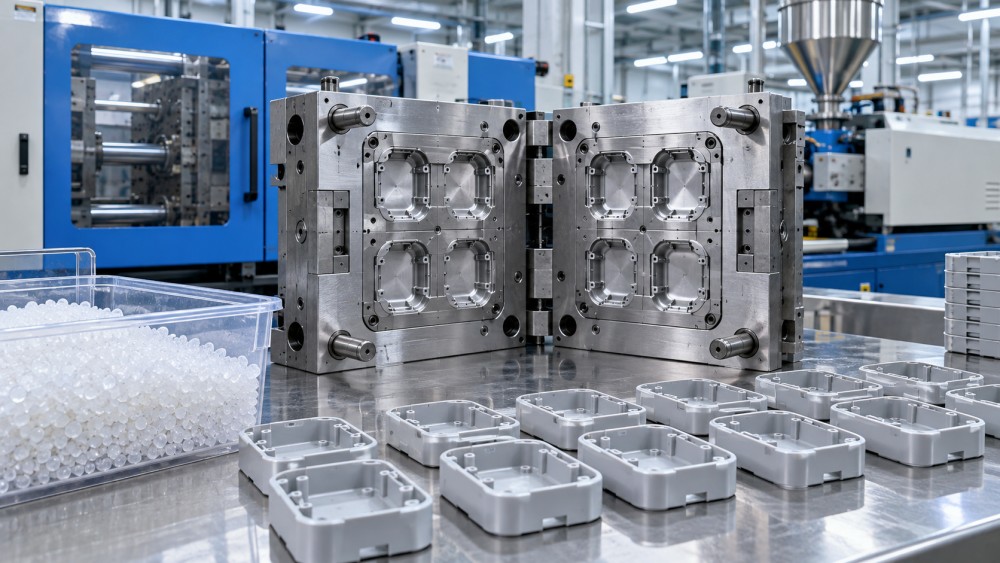
When a supplier proposes a lower price through a faster cycle, ask whether that cycle is a design estimate or has been demonstrated under the agreed quality conditions. Estimated productivity is suitable for preliminary costing, but commercial acceptance should distinguish it from validated production performance.
Volume changes the answer—and order pattern changes it again
Tooling amortization makes high-volume programs look inexpensive per part because the fixed investment is spread across more units. The relevant denominator, however, is a realistic purchased quantity, not the highest number in a sales forecast.
Consider two hypothetical offers for the same approved part. Assume both recurring prices remain valid across the quantities shown, and all other costs are equivalent:
Offer B requires $16,000 more tooling investment and saves $0.18 per part. Its simple break-even quantity is approximately 88,889 parts. Below that quantity, Offer A has the lower combined tooling and production cost; above it, Offer B becomes less expensive under these assumptions.
This calculation excludes financing costs, maintenance differences, and specification changes. If the higher investment is paid well before the parts are purchased, cash-flow timing also matters. If demand is uncertain, calculate low, expected, and high-volume scenarios rather than treating the forecast as a commitment.
Release size introduces a separate cost effect. Ten releases of 5,000 parts can require more setup, scheduling, and startup material than one run of 50,000. A supplier may offer a lower price for larger batches, but the saving must be weighed against inventory financing, storage, and obsolescence. A design change can erase the benefit of buying ahead.
Tooling amortization can hide obligations inside the unit price
A “no upfront tooling charge” offer can still contain a substantial tooling commitment. The supplier may recover the investment through a surcharge, a minimum purchase quantity, an exclusivity period, or a payment due if the program ends early.
Require the agreement to identify the recoverable tooling amount, the recovery method, and what happens after it has been paid. If a surcharge continues indefinitely, the apparent financing arrangement becomes a permanent price premium. If volume falls short, establish whether the remaining balance becomes payable and how it is calculated.
Ownership is a separate issue from payment. Specify who owns the mold, where it is held, who insures it, and whether it can be transferred. Transfer rights are more useful when supported by tool drawings, maintenance records, compatible interfaces, and clearly allocated removal and transport costs. Otherwise, nominal ownership may offer little practical supply flexibility.
Make quote differences visible before negotiating the price
A disciplined comparison uses one drawing revision, one material specification, and one set of commercial assumptions. Without that common basis, a price gap can reflect different scope rather than different supplier efficiency.
The most consequential points to clarify are:
- Production basis: cavity count, proposed cycle, machine requirements, annual quantity, release size, and minimum order.
- Quality scope: critical dimensions, appearance criteria, inspection frequency, traceability, and any application-specific qualification.
- Tooling obligations: acceptance criteria, ownership, included corrections, maintenance responsibility, and repair charges.
- Commercial boundaries: packaging, setup fees, currency, quote validity, price-adjustment rules, and delivery terms.
For cross-border comparisons, normalize quotes to the same landed-cost boundary. The agreed Incoterm should include the named place and applicable version. Freight, insurance, duties, and taxes should be treated consistently; recoverable taxes should not be confused with permanent costs.
Savings negotiations are strongest when tied to a specific mechanism: removing an unnecessary undercut, reducing a thick section, approving a suitable material alternative, consolidating releases, or changing cavity count. Each proposal should identify its tooling impact, recurring saving, and validation requirement. A price reduction without a defined mechanism leaves uncertainty about which assumption has changed.
The lowest defensible injection molding price is the one supported by achievable demand, an accepted production process, and clear contractual boundaries. Before committing, test the preferred offer against lower volume, smaller releases, and an early program exit. Those conditions reveal whether the quoted saving survives the way the parts will actually be purchased.
Related News
- 00
0000-00
How to compare molding equipment for high-volume production - 00
0000-00
EU Tightens Food-Contact Recycled PET Import Controls and Adds Customs Code - 00
0000-00
How to size vulcanizing equipment for rubber hoses - 00
0000-00
Is natural rubber more price volatile than synthetic rubber? - 00
0000-00
EU Tightens Import Controls and Traceability for Food-Contact Recycled PET