



Where Are the Biggest Value Chain Risks in Molded Parts Sourcing?
The largest risks sit at the handoffs, not just at the factory gate
In molded parts sourcing, the most expensive failures rarely begin with an obvious production defect. They build at the points where one decision depends on another: a resin grade is substituted without revisiting tool settings; a die-casting supplier accepts a drawing without fully resolving porosity requirements; a toolmaker and molder work to different assumptions about maintenance; a buyer approves a lower unit price while freight, scrap, and inventory exposure quietly rise.
The biggest value chain risks are therefore concentrated in four connected areas: material continuity and specification control, tooling ownership and process capability, supplier capacity and operational resilience, and traceability across logistics and compliance. Their relative importance depends on the part, application, and annual volume. A cosmetic consumer component may be most exposed to color and surface consistency. A structural automotive casting, medical enclosure, or electrical component can carry far greater risk in material certification, dimensional stability, and process change control.
For buyers, the practical question is not whether every risk can be eliminated. It is whether the sourcing model makes deviations visible early enough to prevent a low-cost part from becoming a quality, delivery, or liability problem later.
Material risk starts with the specification, not the commodity price
Resin, alloy, rubber compound, masterbatch, additives, and recycled feedstock all affect molded-part cost. Price volatility gets the most attention because it is immediately measurable, but price is only one part of the exposure. The greater sourcing risk often arises when the material specification is too broad for the part's functional requirements or too narrow for the available supply base.
A purchase description such as “ABS,” “nylon,” “aluminum alloy,” or “recycled PP” is rarely sufficient for a critical molded part. Within each material family, different grades can behave very differently during processing and in service. Flow behavior, moisture sensitivity, filler loading, shrinkage, thermal expansion, impact performance, chemical resistance, color stability, and recycled-content variation can all affect the finished part. In die casting, alloy chemistry, melt cleanliness, and treatment history may influence strength, corrosion behavior, machinability, and internal soundness.
Substitution is where this risk becomes operational. A supplier may view an alternative grade as technically equivalent because it meets a headline property. The buyer may assume the approved material name controls the outcome. Yet a change in viscosity, glass-fiber content, pigment package, or recycled fraction can alter fill pressure, weld-line appearance, warpage, cycle time, sink marks, and tool wear. The part can still pass an initial dimensional check while becoming less stable across production lots.
Material continuity should be managed through an approval structure that matches the risk of the part. At minimum, the specification should identify the approved grade or grades, relevant material properties, color or appearance requirements where applicable, documentation expected per lot, and the conditions under which substitution requires written approval. For performance-critical components, the supplier's material traceability should connect incoming lots to production batches and finished-part lots.
Recycled and bio-based materials require particularly careful wording. Their use may support circularity goals, but “recycled content” is not a complete technical instruction. Buyers need to define the acceptable source, allowable variation, contamination controls, verification method, and performance limits for the application. A sustainability target that is disconnected from molding trials, qualification data, and end-use demands can transfer uncertainty straight into production.
Tooling is the point where commercial assumptions become physical constraints
Tooling risk is often underestimated because it is treated as a one-time capital purchase rather than a production asset with a long operating life. In reality, the mold or die determines much of the part's repeatability, cycle time, cosmetic quality, yield, and ability to scale. A weak tooling decision can survive the first samples and only become visible when volume, maintenance needs, or tighter quality expectations arrive.
The first question is ownership. A buyer may pay for tooling but still lack clear contractual rights to drawings, design files, maintenance records, spare inserts, and physical possession of the tool. That becomes serious when a supplier relationship deteriorates, a factory changes ownership, or production needs to move. Tool transfer is not always quick or technically simple. The new molder may need to validate the tool, adapt it to different machines, replace damaged components, or uncover undocumented modifications.
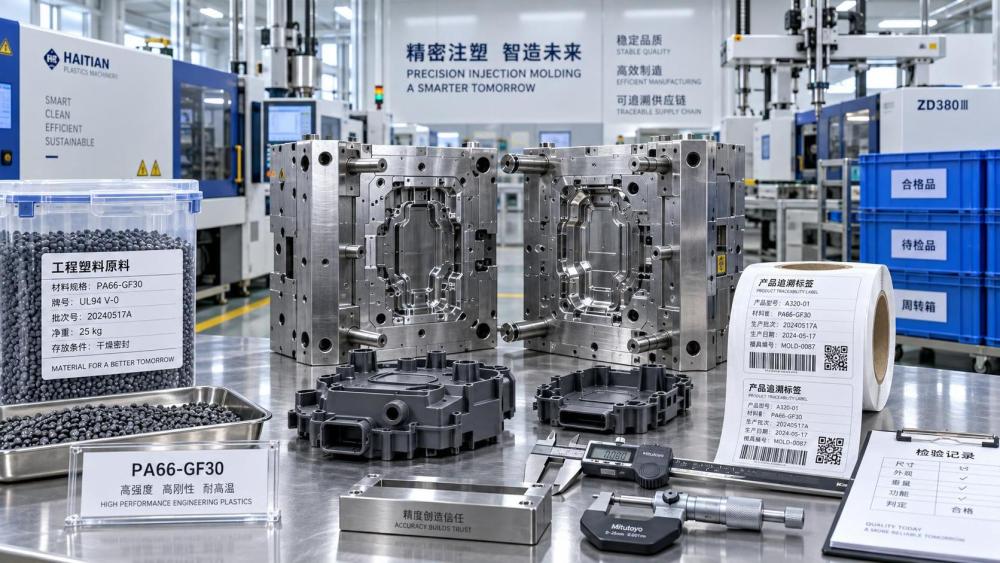
Tool design also needs to be evaluated against the intended production reality. A mold designed for a pilot run may not be suitable for sustained output. Gate design, cooling layout, venting, ejection, steel selection, surface treatment, cavity balance, hot-runner configuration, and tolerance stack-up all influence stability. For die casting, thermal management, die lubrication, vacuum support, trimming, and expected die life may be equally consequential.
A part drawing alone cannot resolve these issues. The sourcing package should establish which dimensions are critical, what measurement method applies, acceptable appearance standards, expected annual volumes, machine constraints, resin or alloy assumptions, and validation requirements before full production approval. This is especially important for parts with thin walls, tight flatness requirements, inserts, threads, sealing surfaces, complex textures, or high cosmetic expectations.
There is also a commercial trap in comparing tool quotes line by line without comparing tool scope. A lower quote may omit mold-flow analysis, hardened inserts, spare components, inspection fixtures, texture control, lifecycle maintenance, or trial runs. Those omissions do not disappear. They reappear later as engineering changes, production interruptions, disputed defects, or a tool that cannot reliably achieve the quoted unit price.
Questions that expose tooling risk early
- Who owns the tool, its design data, and its maintenance history after payment?
- Which tool components are consumable or likely to require replacement at forecast volume?
- Are cycle-time assumptions demonstrated during production-representative trials?
- Which dimensions depend on post-molding conditioning, machining, assembly, or measurement temperature?
- What process changes can the supplier make without customer approval?
- Can the tool be transferred, and what records and validation activities would that require?
Capacity risk is usually a planning problem before it becomes a factory problem
A supplier may have sufficient machines on a site visit and still be unable to support a program reliably. Nominal press capacity is not usable capacity. Availability depends on machine tonnage, shot size, automation, mold compatibility, labor, drying and material-handling capability, secondary operations, inspection resources, maintenance downtime, and the supplier's commitments to other customers.
This distinction matters most when a part depends on a specific machine class or process window. A large cosmetic housing may require a particular press size and robotic handling arrangement. A precision component may need a stable, well-maintained machine rather than any available press. A die-cast part may rely on a cell that includes melting, casting, trimming, leak testing, machining, and finishing. A disruption in any one stage can constrain shipments even if the molding machine itself is running.
Capacity exposure also grows when the buyer awards a program to a single source solely because the initial price is attractive. Sole sourcing can be appropriate for proprietary tooling, highly specialized processes, or modest demand. It becomes fragile when the part is production-critical, lead times are long, tooling cannot be duplicated quickly, or the supplier has limited financial and operational headroom.
A dual-source strategy is not automatically the answer. Two suppliers using different material lots, tooling designs, process controls, or inspection methods can introduce more variability than they remove. The more useful approach is to identify where continuity matters most and create a practical fallback. That may involve duplicate tooling, a qualified secondary molder, retained safety stock of high-risk components, standardized material options, or a documented transfer plan. The right choice depends on the cost of interruption, not on a generic preference for supplier diversification.
Buyers should also test quoted lead times against the full path to shipment. The relevant clock begins with material availability and production scheduling, then includes molding or casting, conditioning, machining or assembly, inspection, packaging, export preparation, and transport. A supplier that quotes an impressive manufacturing lead time may still be unable to protect the required delivery date when raw material allocation, port congestion, customs paperwork, or a failed final inspection intervenes.
Quality risk often hides in uncontrolled process changes
Many molded parts fail not because the original process was incapable, but because the production process changed after qualification. This can happen gradually: a new resin distributor is used, a cavity is repaired, a tool is moved to another press, drying settings are adjusted to recover output, a shift changes, a gauge is replaced, or regrind content increases. Each decision may seem small in isolation. Together, they can shift the part away from the condition that was validated.
For this reason, a certificate of conformance is not a substitute for process discipline. Documentation matters, but it should be linked to meaningful controls: incoming material identification, defined processing windows, first-off and in-process inspection, gauge calibration, nonconformance handling, retention of samples where appropriate, and documented change notification.
The level of control should follow the consequences of failure. For a low-value, non-safety-critical molded accessory, visual standards and dimensional sampling may be enough. For a component affecting structural load, sealing, fluid contact, electrical insulation, medical use, or regulated end products, the buyer may need more formal qualification, lot traceability, validation records, and explicit restrictions on material or process changes.
Logistics and compliance can invalidate an otherwise sound sourcing decision
Molded-part sourcing is often evaluated at ex-works price, while the business impact occurs at delivered cost and delivered reliability. Bulky plastic parts can be disproportionately exposed to freight cost because they ship more air than mass. Metal castings may need corrosion protection, careful dunnage, or export packaging that adds cost and handling. Parts with cosmetic surfaces can suffer damage that is not visible until unpacking at the receiving site.
Packaging specifications deserve the same attention as part specifications when damage, deformation, contamination, or lot mixing would create downstream risk. A packaging proposal should account for the component's geometry, surface sensitivity, stacking limits, humidity exposure, and handling path. It should also define labeling sufficient to preserve lot identity through warehouses and distribution points.
Compliance risk varies by product and destination, but it should not be deferred until shipping. Material declarations, restricted-substance requirements, origin documentation, safety records, and sector-specific expectations can affect whether a part is acceptable for the final product. The relevant obligation may sit with the brand owner or importer, yet evidence often needs to come from the molder, material producer, or sub-supplier. If the chain is opaque, a buyer may learn too late that a material or coating cannot be supported with the required documentation.
Carbon-related reporting and recycled-content claims create a similar evidence problem. A molded part can be marketed internally as a lower-impact alternative, but the claim is weak if the buyer cannot identify the material basis, production boundaries, and documentation trail behind it. Procurement teams should separate a supplier's ambition from the records needed to support a customer, regulatory, or internal reporting requirement.
Build a risk map around the part, not around a generic supplier scorecard
Generic supplier questionnaires have value, but they often produce a false sense of control. A supplier can score well across broad categories and still be a poor fit for a particular molded part. The most useful risk assessment begins with the part's failure modes and works backward through the value chain.
Start by asking what would make the component unacceptable in its final use: dimensional drift, loss of strength, cosmetic inconsistency, leakage, odor, electrical failure, delayed delivery, inability to document material content, or inability to transfer production. Then identify the upstream conditions that could cause each outcome. This turns supplier evaluation from a checklist exercise into a targeted review of materials, tooling, processes, capacity, logistics, and evidence.
For many programs, the highest-return actions are straightforward: lock down the material and change-control rules; establish clear tool ownership and maintenance responsibilities; validate output under representative production conditions; connect finished lots to material and process records; and decide in advance how continuity will be protected if the primary source fails.
The goal is not to make molded-parts sourcing administratively heavy. It is to place control where value is most easily lost. When the commercial agreement, tool strategy, process requirements, and supply-continuity plan all reflect the actual function of the part, buyers are far less likely to discover their biggest risks after production has already begun.
Related News
- 00
0000-00
How evolutionary trends in automation are reshaping manufacturing investment - 00
0000-00
When data-driven intelligence sourcing reduces supplier risk - 00
0000-00
How Mold and Die Simulation Cuts Trial Cycles in Complex Injection-Molding Programs - 00
0000-00
Russia’s Rubber Molding Market: Demand Drivers, Supply Risks, and Growth Segments - 00
0000-00
Where Are the Biggest Value Chain Risks in Molded Parts Sourcing?