


Which Decarbonization Projects Pay Back Fastest in Molding Plants?
Which decarbonization projects pay back fastest in molding plants? Usually, the first winners are not new presses, electric furnaces, or rooftop solar. They are repairs and operating changes that stop energy being consumed without producing a saleable part: compressed-air leaks, machines left fully energized between jobs, poorly controlled cooling systems, and unnecessary heating.
That answer is encouraging for plant managers facing tight capital budgets. It also needs qualification. A leak repair only saves electricity if the compressor responds to lower demand. A temperature adjustment is not a saving if it creates rejects. And an attractive equipment proposal can disappoint when its calculations assume more operating hours than the plant actually runs.
The practical task is to find avoidable losses, verify their cost, and remove them without destabilizing production. Across injection molding, die-casting, extrusion, and rubber processing, the following approach helps separate quick returns from projects that need a longer investment horizon.
Start with the losses that continue when production stops
Walk the plant during a break, changeover, or weekend shutdown. Listen for escaping air. Look for dryers running without material demand, pumps serving idle machines, and heaters maintaining production temperatures on equipment that will not restart for hours.
These observations often reveal better starting points than a comparison of machine nameplate ratings. Installed power describes capacity, not actual consumption. What matters is the load profile: how much energy equipment draws, for how long, and whether that energy supports useful production.
A practical initial ranking looks like this. It is a screening order, not a promise of universal payback periods.
Compressed air: repair the leaks, then make the savings real
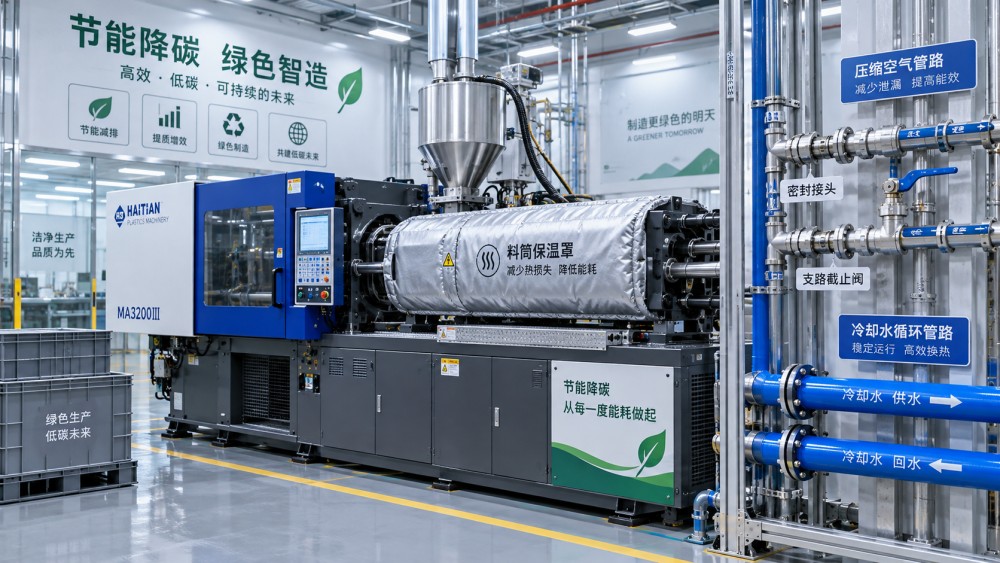
Compressed air is a strong early candidate because leaks can consume energy throughout operating hours, including periods when machines produce nothing. Check couplings, hoses, valve assemblies, pneumatic equipment, and distribution branches serving retired or rarely used machinery.
Tag leaks, assign repair responsibility, and retest them. Where safe, isolate unused branches automatically rather than relying on someone remembering a manual valve at the end of each shift.
The important second step is compressor control. Reducing air demand does not necessarily reduce electrical consumption in proportion. An unloaded compressor may still draw significant power, and poorly coordinated units can continue running unnecessarily. Review sequencing and compare compressor kilowatts before and after repairs under similar production conditions.
Pressure reduction can add savings, but measure pressure at critical users during peak demand first. A pressure drop caused by an undersized pipe, blocked filter, or local restriction should not be disguised by raising pressure throughout the plant. Nor should pressure be lowered blindly where it affects actuators, handling systems, or safety-related functions.
Idle settings often beat replacement projects on speed
A molding machine waiting for its next job may still consume electricity through hydraulic pumps, heaters, controls, and auxiliaries. The quickest opportunities often involve the entire cell rather than the press alone.
Build a shutdown matrix covering short interruptions, meal breaks, extended changeovers, and overnight stops. For each condition, specify which equipment remains active, which enters standby, and which can stop completely. Include dryers, mold-temperature controllers, conveyors, extraction systems, and dedicated cooling pumps.
The distinction matters. Switching off barrel heaters during a brief interruption may save little once reheating is included. Shutting down an unnecessary auxiliary overnight can be much more attractive. Polymer residence-time limits, material degradation, drying requirements, and restart procedures must guide the settings.
For die-casting and rubber processing, thermal readiness can be particularly sensitive. Holding furnaces and curing systems should follow approved operating procedures rather than a generic “switch everything off” policy. Measure the full stop-and-restart cycle, including startup scrap, before declaring a saving.
Cooling and heating: remove excess, not process control
Thermal utilities are productive assets when they maintain the right process conditions. They become expensive when the plant supplies more cooling or heating than the process requires.
Separate cooling duties before changing setpoints
A common issue is supplying chilled water to loads that could operate with warmer process water. Hydraulic oil cooling, mold cooling, and other duties may have different temperature requirements. Separating suitable circuits can reduce refrigeration demand, although piping modifications may change the payback.
Begin with lower-cost checks: clean heat exchangers, inspect strainers, correct bypass flows, verify sensors, and review chiller sequencing. Where equipment and ambient conditions permit, assess economizer or free-cooling operation.
Do not assume warmer mold water always improves plant economics. It may increase cooling time or affect shrinkage, warpage, surface finish, and dimensional consistency. Compare utility savings with throughput and quality, not just chiller electricity.
Inspect heat losses and drying practice
Damaged insulation, exposed hot surfaces, poorly fitting furnace covers, and unnecessary hot-air losses deserve attention. Barrel insulation can reduce heat loss in suitable applications, but it must remain compatible with cooling requirements, electrical safety, inspection, and maintenance.
For polymer dryers, match operation to material throughput and supplier requirements. Check airflow, dew point, temperature, residence time, and hopper loading. Lowering temperature without confirming moisture performance can turn a small energy saving into costly defects.
In metal casting, follow validated practices for holding temperature and furnace access. Never compromise charge preparation, moisture precautions, or melt quality in pursuit of fuel savings.
Calculate payback on the whole production system
Simple payback is useful for screening projects:
Simple payback, in years = total installed project cost ÷ annual net operating savings.
Include engineering, installation, commissioning, planned downtime, and training in project cost. Annual net savings should account for energy, relevant demand charges, maintenance changes, consumables, and any effect on scrap or output.
Consider a purely illustrative example. A plant spends $6,000 on leak repairs and control adjustments. Measurements indicate an average compressor reduction of 8 kW over 6,000 operating hours annually. At an electricity energy rate of $0.12/kWh, annual electricity savings would be $5,760, giving a simple payback of approximately 1.04 years before other cost changes.
This is calculation practice, not an industry benchmark. If the measured reduction were only 3 kW, or the system operated fewer hours, the return would be slower. Demand-charge savings should be counted only if the project reduces the demand used for billing.
Avoid counting the same saving twice. Leak repairs and compressor sequencing interact; their separately estimated benefits may not be additive. Similarly, insulation, lower standby temperatures, and heat recovery can compete for the same thermal energy.
Keep carbon calculations separate from cash calculations
Financial savings depend on tariffs. Emissions savings depend on energy quantities and the applicable emissions factors. For electricity, calculate avoided kilowatt-hours multiplied by the factor appropriate to the reporting method. For fuel, use the relevant fuel emissions factor and consistent units.
Document the assumptions. Electricity emissions vary by location and accounting approach, so identical energy savings can produce different reported carbon reductions. A low-carbon electricity supply also changes the relative attractiveness of electrification compared with fuel-efficiency improvements.
Fast financial payback and large carbon abatement are related goals, not interchangeable measures.
Scrap reduction can outperform a utility project
A rejected part has already consumed material, drying, heating, machine time, cooling, and handling. Remelting or regrinding it does not recover all of that energy or value.
In injection molding, investigate moisture variation, inconsistent material preparation, unstable mold temperatures, and avoidable startup losses. In extrusion, examine startup scrap, dimensional variation, and unnecessary material giveaway. Die-casting investigations may focus on thermal instability, filling consistency, and defects; rubber processors should review cure consistency and compound handling.
These projects can have attractive returns because material savings may exceed energy savings. However, they require disciplined validation. A faster cycle or lower temperature is not an improvement if it increases returns, shortens tool life, or pushes quality problems downstream.
Track energy per saleable unit or kilogram alongside absolute energy use, reject rate, and throughput. This prevents a quieter production week from being mistaken for an efficiency improvement. Keep product mix visible: a plant making more demanding parts may consume more energy per kilogram without operating less efficiently.
When larger investments deserve priority
Quick-payback measures should not become an excuse to postpone every structural change. High operating hours, aging equipment, expensive maintenance, or a planned capacity expansion can make a larger investment commercially sensible.
- Servo or variable-speed upgrades: assess the actual load profile, control compatibility, cooling needs, and installed cost rather than relying on headline efficiency claims.
- Heat recovery: identify a nearby heat user with matching temperature requirements and operating hours. Recoverable heat has little financial value without useful demand.
- Machine replacement: compare equivalent production duties and include auxiliary loads, quality, cycle time, reliability, and maintenance.
- Electrification and renewable electricity: evaluate tariffs, grid capacity, emissions factors, operating schedules, and longer-term carbon objectives.
Simple payback alone is inadequate for these decisions. Use lifecycle cost or discounted cash-flow analysis, test different energy prices, and evaluate installation risk. Separate discretionary energy improvements from replacements already required for reliability or capacity.
A practical first 90 days
During the first month, establish a usable baseline from utility bills, operating schedules, production records, and targeted metering. Inspect nonproduction loads and create a short opportunity register with an owner for each item.
Over the following month, trial a manageable set of changes: repair priority air leaks, adjust one cell’s standby logic, correct a cooling-control issue, or address a recurring scrap cause. Agree on quality and throughput limits before each trial.
Use the final month to verify results, standardize successful settings, and build the next investment case. Compare matched operating conditions and retain records of settings, maintenance, and production changes. Without ownership and follow-up, leaks return and optimized controls drift.
GPM-Matrix’s cross-process perspective connects these decisions across polymer and metal molding: evaluate the material, machine, and utility system together. The fastest-paying decarbonization projects usually remove persistent losses with modest intervention. The strongest program then reinvests those verified savings in deeper improvements—without asking production teams to trade dependable output for an untested carbon claim.
Related News
- 00
0000-00
How to compare molding equipment for high-volume production - 00
0000-00
EU Tightens Food-Contact Recycled PET Import Controls and Adds Customs Code - 00
0000-00
How to size vulcanizing equipment for rubber hoses - 00
0000-00
Is natural rubber more price volatile than synthetic rubber? - 00
0000-00
EU Tightens Import Controls and Traceability for Food-Contact Recycled PET