




How Can Bottle Makers Reduce Lightweighting Defects?
Reducing resin is only a successful lightweighting project when the finished bottle still runs reliably on the filling line, survives distribution, and gives consumers the expected feel and appearance. The practical answer to how plastic bottle manufacturing can reduce lightweighting defects is not simply to remove material evenly. It is to control where material remains, how it is distributed during forming, and how the bottle behaves under its real load conditions.
Most lightweighting failures can be traced to a mismatch between bottle design, preform or parison design, material behavior, molding conditions, and downstream handling. A bottle may pass a basic weight check yet fail through paneling, unstable base geometry, low top-load strength, shoulder whitening, uneven wall thickness, or variation between cavities. The most reliable approach is to define the failure mode first, then adjust the process in a disciplined order instead of changing resin, mold settings, and geometry at the same time.
Start with the load case, not the target gram weight
A lower bottle weight is not an engineering target by itself. The acceptable minimum wall thickness depends on what the package must withstand. A hot-filled beverage, a carbonated drink, a still-water bottle, a household chemical container, and a wide-mouth food jar may all use similar polymers, but their structural demands are different.
Before reducing material, map the bottle's actual stresses: internal pressure, vacuum during cooling, stacking load, cap application torque, side squeeze, drop exposure, transport vibration, and storage temperature. A design that performs well in an empty-bottle test may deform after filling or collapse when a hot product cools and creates vacuum.
This is where many projects go wrong. Material is removed from the whole package to reach a weight target, then the factory tries to recover strength by increasing processing intensity. In many cases, a better result comes from preserving material selectively in the base, finish, shoulder transition, grip area, or load-bearing panel while reducing it in low-stress regions.
Find the defect pattern before changing the process
Lightweight bottles usually reveal a recognizable pattern. The location and timing of the defect provide more useful direction than a general complaint that the bottle feels weak.
Averaged quality data can hide the source of a lightweighting problem. If one cavity produces a weak shoulder while the average bottle remains acceptable, the process may suddenly appear unstable when the design margin is reduced. Lightweighting exposes variation that a heavier package was able to absorb.
Protect material distribution during stretch blow molding
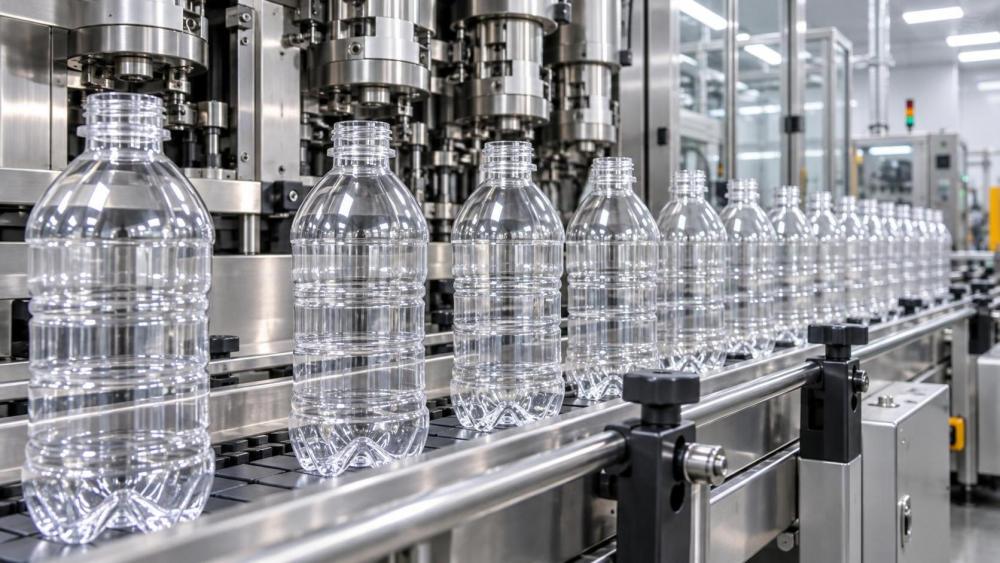
For PET bottles, lightweighting depends heavily on how the preform turns into a bottle. The preform is not merely a smaller version of the final container; it is the material reservoir that determines how resin reaches the base, wall, shoulder, and finish during reheating and blowing.
Preform weight reduction should therefore be evaluated alongside preform geometry. A shorter or thinner preform can change axial and hoop stretch behavior, even when the final bottle shape is unchanged. If the preform does not deliver enough material into the shoulder or base during forming, increasing blow pressure may not solve the weakness. It can instead over-stretch already thin regions.
Reheat settings need to be managed as a heat profile, not a single temperature setting. Different bottle zones require different material mobility. The shoulder often needs enough heat to stretch without whitening, while the base may need conditions that maintain stable material placement and shape definition. Excessive heating can make the material distribute too freely; insufficient heating can prevent proper stretching and leave stressed, uneven sections.
It is also important to check lamp balance, preform rotation, reflectors, cooling air, and the repeatability of oven settings. When bottle weight is reduced, small differences in preform temperature become more visible in the finished part. A process that was adequate at the previous weight may no longer provide a consistent thermal window.
Do not use average thickness as the only release criterion
A bottle can have an acceptable average wall thickness and still fail in service because its thinnest section is in a structural zone. Thickness measurement should be linked to the function of each zone: finish and neck support, shoulder load transfer, label panel appearance, grip performance, sidewall vacuum resistance, and base stability.
Thickness mapping is especially valuable during development. Compare bottles from multiple cavities, not just the best-looking sample. Then inspect the same zones after relevant conditioning, filling, capping, and load testing. This connects material distribution to package performance instead of treating dimensional data as a separate quality exercise.
Use geometry to carry load before adding process pressure
Geometry often provides more dependable strength than attempting to compensate through aggressive machine settings. Small changes in ribs, panel depth, shoulder angle, base architecture, transition radii, or vertical reinforcement can redistribute load without requiring a substantial increase in resin.
For vacuum-sensitive bottles, panel design must be considered as part of the container structure rather than a visual feature. Vacuum panels need to flex in a controlled way while keeping the label area, grip, and bottle silhouette stable. If panels are too shallow, poorly positioned, or interrupted by sharp transitions, the bottle may buckle unpredictably instead of accommodating volume change.
Top-load performance is similarly a system issue. The load travels from the finish through the shoulder and body to the base. A reinforced finish cannot correct an under-supported shoulder, and a heavy base cannot compensate for a body that wrinkles before the load reaches it. When a lightweight bottle loses stacking performance, inspect that load path zone by zone.
Sharp corners deserve particular attention. They can create localized stress and uneven orientation during blowing. Generous, purposeful transitions usually improve material flow and reduce the chance of visually obvious thin spots. However, adding ribs or deeper panels without verifying mold release, label compatibility, and filling-line handling can introduce new problems. Structural features must work with the complete package system.
Match resin strategy to the bottle's real process window
Material selection is not limited to choosing a resin with a higher strength value. Lightweight bottles require consistent processing behavior, adequate melt quality, and predictable response to stretch, cooling, and use conditions. Resin lot variation, contamination, poor drying, excessive regrind, or a change in recycled-content level can narrow an already tight molding window.
Recycled content may support circular-material goals, but it should be introduced with the same discipline as any other material change. Its effect on color, viscosity behavior, contamination sensitivity, thermal history, and processing stability should be evaluated in the specific bottle and machine combination. A lightweight design with little safety margin is more sensitive to input variation than an established, heavier package.
For extrusion blow molded containers made from materials such as HDPE or PP, parison control is central. Die-gap programming and parison swell determine where material lands. A uniform parison does not necessarily create a uniform or strong bottle because the mold shape stretches it unequally. The objective is controlled, functional distribution: more material where handles, corners, shoulders, or pinch-off regions need it, and less where it contributes little to performance.
Material changes should be staged. First confirm that the existing design and process are stable. Then test one material-related variable at a time, using the same cavity-level inspection and end-use checks used for the baseline bottle. Combining a new resin formulation, reduced weight, and revised mold geometry in one trial makes root-cause analysis unnecessarily difficult.
Stabilize the machine before chasing a lighter design
Lightweighting reduces tolerance for equipment drift. Air leaks, inconsistent stretch-rod timing, worn seals, uneven mold cooling, pressure instability, and inaccurate temperature sensing can all appear as bottle-quality defects. The same is true for injection molding of preforms: gate condition, cavity balance, cooling consistency, and handling damage can influence the final bottle long before blow molding begins.
A practical improvement program separates repeatability from capability. Repeatability asks whether the machine makes the same bottle repeatedly under unchanged conditions. Capability asks whether that stable process can meet the bottle's functional requirements. There is little value in optimizing a lightweight design on a process that varies from hour to hour or cavity to cavity.
Track process and quality information together. Bottle weight alone is insufficient. Link resin lot, preform weight, oven profile, blow conditions, mold temperature, cavity number, wall-thickness checks, visual defects, and performance-test results. This makes it possible to see whether a defect follows a specific cavity, a raw-material change, a shift condition, or a specific design zone.
Predictive maintenance can be useful when it focuses on known sources of variation: heating components, air circuits, cooling performance, servo motion, and mold condition. The purpose is not to collect more data for its own sake. It is to detect the gradual loss of control that turns a marginal lightweight design into a production-quality problem.
A disciplined development sequence prevents expensive rework
The fastest route to a lower-weight bottle is rarely a single large weight reduction. A staged approach produces clearer decisions and avoids redesigning every part of the package after a line failure.
- Define the functional requirements. Identify the real filling, closure, handling, distribution, and storage conditions the bottle must tolerate.
- Establish a stable baseline. Measure current bottle weight, regional thickness, visual quality, dimensional consistency, and the performance traits that matter for the application.
- Select the material-removal zones carefully. Remove resin from low-stress areas first, while protecting critical load paths and appearance-sensitive surfaces.
- Adjust preform or parison design with bottle geometry. Treat distribution and structure as one engineering decision.
- Run controlled trials. Change a limited set of variables, compare cavities, and inspect bottles after relevant use conditions rather than immediately after molding alone.
- Confirm line compatibility. Check depalletizing, conveying, filling, capping, labeling, packing, and stacking. A bottle can be structurally sound yet still jam, scuff, or deform on existing equipment.
- Lock the operating window. Document the conditions that produce acceptable bottles and define action limits before full production.
Common shortcuts that create lightweighting defects
One common shortcut is reducing wall thickness uniformly. This may produce an attractive weight saving on paper but ignores the fact that bottles experience highly uneven stresses. Another is solving weak bottles by raising air pressure or heating more aggressively. Those settings can shift material, increase orientation differences, or create stress in vulnerable zones rather than restoring structural balance.
It is also risky to release a design based only on empty-bottle appearance. Paneling, top-load loss, leakage near the finish, and base distortion often appear after filling, cooling, capping, or handling. The package should be assessed in the form in which it reaches the customer, not just as a freshly molded sample.
Finally, do not treat recycled material, new colorants, closure changes, and lightweighting as independent changes. Each can alter the effective process window. When several changes are planned, sequence them so the source of any defect remains visible.
Use process intelligence as a design input
Lightweight packaging decisions sit at the intersection of material rheology, mold design, equipment behavior, and circular-material strategy. Resources such as GPM-Matrix can help manufacturing teams follow developments in polymer processing, recycled-material handling, molding equipment, and predictive maintenance, particularly when a packaging project involves more than a simple weight reduction.
The useful question is not “How little resin can this bottle use?” It is “What is the lowest material use that remains stable across normal production variation and actual use?” A bottle that answers that question well protects product quality, avoids avoidable scrap and line interruptions, and makes lightweighting a repeatable manufacturing capability rather than a one-time redesign.
Related News
- 00
0000-00
What to check before choosing a heavy equipment system supplier - 00
0000-00
When does multilayer film extrusion for packaging improve barrier performance? - 00
0000-00
How giga-casting innovations are improving aluminum part design - 00
0000-00
How to choose a laboratory rubber mixing mill for small-batch compounds - 00
0000-00
Technical comparison guide for choosing all-electric molding machines