



What Contamination Level Is Acceptable for Plastic Pelletizing?
There is no single contamination percentage that is “acceptable” for plastic pelletizing. A feedstock containing 3% contamination may be commercially workable for a dark, low-specification polyolefin product, while 0.3% may be unacceptable for a light-colored injection-molding grade. The practical limit is set by the required pellet quality, polymer family, sorting and washing capability, melt-filtration design, and the value lost through rejects, screen changes, downtime, and downgraded output.
The useful question is not simply how much contamination is present at the bale or flake stage. It is whether each contaminant can be removed, tolerated, or managed without creating unacceptable variation in the finished pellets. Paper, metals, moisture, incompatible polymers, organics, and residual chemicals behave very differently in an extrusion line. Treating them as one combined number can hide the risks that matter most.
Start with the finished-pellet specification, not the incoming bale
Acceptable contamination must be defined backward from the final application. Recyclate intended for noncritical products such as certain outdoor, black, or thick-wall applications can often tolerate a broader feedstock window than material intended for thin-wall packaging, light colors, film, fibers, electrical parts, or precise injection-molded components. In high-appearance or high-performance applications, small amounts of incompatible polymer may cause gels, streaks, brittleness, odor, unstable melt flow, or visible black specks even when the total contamination figure appears low.
A practical incoming-material specification should separate contamination into categories rather than relying only on “total non-plastic.” At minimum, it should distinguish:
- Target polymer content and polymer-family purity;
- Other plastics, especially those with incompatible melting behavior;
- Metals, including ferrous, nonferrous, and fine metallic particles;
- Paper, labels, wood, textiles, sand, glass, and mineral debris;
- Food residues, oils, detergents, adhesives, and other organics;
- Moisture, measured on a clearly defined sampling basis;
- Color mix, black-speck level, odor, and visible degradation where relevant.
For trade and procurement purposes, the specification also needs to state where measurement occurs: at receipt, after sorting, after washing, after drying, or in finished pellets. A shipment that is acceptable as mixed post-consumer feedstock may be completely unsuitable if represented as washed, extrusion-ready flake. Confusion over the sampling point is a common source of quality disputes.
Useful operating ranges are category-specific
The figures below are not universal product standards. They are practical starting points for defining internal controls and supplier agreements. They should be tightened or relaxed only after trial runs demonstrate stable throughput, filtration performance, pellet quality, and suitability in the intended conversion process.
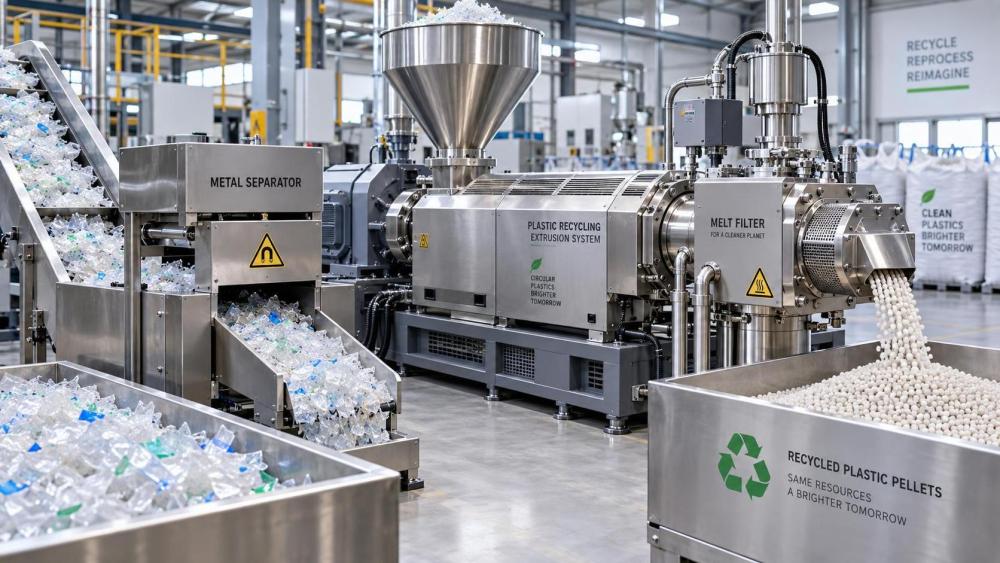
For many polyolefin recycling lines, a washed-flake feed containing a few percent of residual non-polymer material is already likely to create a costly balance between screen-pack consumption and output quality. The acceptable level falls sharply when the line is making natural or light-colored pellets, thin-film grades, or material for applications with strict visual and mechanical requirements. Conversely, a robust line producing dark, filled, or low-appearance compounds may handle dirtier feedstock, but only if the contamination is not metal-rich, highly abrasive, or chemically problematic.
Metal deserves separate treatment. Even a small number of metal pieces can create damage disproportionate to their mass percentage. Magnets, metal detectors, eddy-current separation where appropriate, and disciplined inspection of incoming material are therefore essential. “Low metal content” is not an adequate process safeguard when a single fragment can damage rotating equipment or block a die.
Incompatible polymers usually matter more than visible dirt
Visible contamination is easy to identify and often receives most of the attention. Yet polymer cross-contamination is frequently the more serious quality issue. PET in a polyolefin stream, PVC in a PET stream, polyamide in polyethylene, or silicone-containing materials in other streams can each create different processing and end-use problems. The severity depends on concentration, particle size, dispersion, temperature history, and the compatibility of the polymers involved.
PVC contamination in PET recycling is a well-known example of why total contamination alone is misleading. Under PET processing temperatures, PVC can degrade and release acidic compounds that promote degradation and discoloration. A very low concentration may therefore be consequential. Similarly, small quantities of high-melting polymers in a lower-temperature polyolefin melt can survive as visible particles or gels. If the finished material is used for film or thin-wall molding, these defects can cause breakage or reject rates downstream.
Sorting technology should be chosen around the contaminants that cannot be tolerated. Near-infrared sorting can separate many polymer types, but performance is influenced by particle size, color, surface condition, moisture, labels, and the detectability of the specific materials. Black plastics, multilayer structures, filled compounds, and heavily contaminated flakes can require additional process controls or may remain difficult to separate reliably. Pelletizing cannot correct a polymer-identification problem that remains unresolved upstream.
Moisture limits depend on chemistry, not on appearance
A flake stream can look dry while still carrying enough moisture to damage certain polymers during melt processing. Polyethylene and polypropylene are comparatively less sensitive to hydrolysis than hygroscopic engineering polymers, although excessive water can still destabilize processing, increase venting demand, and contribute to pellet defects. PET, polyamide, polycarbonate, and similar resins require substantially more rigorous drying because moisture at processing temperature can break polymer chains and lower molecular weight.
For this reason, a moisture target should never be copied from one recycling operation to another without reference to resin type, residence time, processing temperature, vacuum venting, and final performance requirements. A hand-held surface measurement or a visual inspection of flakes is not a substitute for a representative moisture test. The sampling procedure matters: material taken immediately after a dryer may not represent material held in an open hopper or exposed to humid ambient air before extrusion.
Where hydrolysis is a concern, monitor properties that reveal degradation rather than relying on moisture alone. Depending on the polymer, this may include intrinsic viscosity, melt flow rate, tensile behavior, impact performance, or molecular-weight-related laboratory analysis. Moisture is a process input; the property shift in the pellet is the commercial consequence.
Filtration capacity does not make contamination free
Fine-screen filtration is often treated as the answer to dirty feedstock. It can remove solid contaminants and improve pellet appearance, but it does not remove dissolved contamination, fully dispersed incompatible polymers, odor-causing compounds, or all degradation products. It also imposes a cost. Finer screens raise pressure, shorten screen-change intervals, increase energy demand, and can reduce throughput. When contamination is high, the usable polymer trapped in the screen pack becomes a direct yield loss.
The relevant calculation is therefore broader than whether the extruder can continue running. A line may technically process a contaminated feedstock while producing pellets that require discounting, blending, or restricted end uses. The apparent advantage of lower-cost feedstock can disappear after accounting for washing losses, filtration media, maintenance, labor, waste disposal, energy, and lower sale value.
Screen-pack differential pressure is one of the most useful operating indicators. A stable pressure rise over time suggests that the incoming material and filtration system are reasonably matched. Rapid or highly variable pressure increases point to inconsistent feedstock, insufficient upstream cleaning, excessive fines, or a screen configuration that is too restrictive for the contamination load. The remedy is not automatically a larger extruder or more aggressive filtration; it may be better bale inspection, improved washing, removal of fines, or tighter sorting.
Measure contamination in a way that supports decisions
A supplier specification without a sampling and test method is difficult to enforce. Contamination is rarely uniform within a bale, container, big bag, or silo. Lightweight film, labels, wet residues, fines, and metal fragments segregate differently. Small grab samples can easily understate the problem.
A workable control plan normally defines the lot size, number of increments, sampling locations, combined sample mass, sorting method, drying condition, and reporting units. Results should identify whether percentages are measured by wet mass, dry mass, or count. Wet-basis reporting can obscure the true quantity of solids in material with high residual moisture. For metal and large foreign objects, count-based reporting and maximum particle-size limits may be more meaningful than a single mass percentage.
Finished-pellet testing should link directly to the intended market. Melt flow rate can indicate variability or degradation, but it cannot alone prove polymer purity. Ash content can reveal inorganic residues but will not identify incompatible plastics. Visual black-speck tests can be useful for appearance-critical grades, while filter pressure value testing may provide a more direct indication of contamination that challenges downstream processing. Odor assessment, volatile analysis, color measurement, density, and mechanical testing may also be justified where the application demands them.
Set contamination limits by commercial grade
A single acceptance limit for all recycled pellets encourages unnecessary conflict. A better system is to define grades according to use. For example, a dark general-purpose regrind grade may allow more color variation and residual specks than a natural injection-molding grade. A material intended for sheet or pipe may prioritize consistent melt flow and long-term strength, while film production may be highly sensitive to gels and unmelted particles.
Each grade should state the properties that cannot vary beyond the buyer’s processing window. This changes the negotiation from an abstract debate over contamination percentage to measurable performance. If a buyer can process a pellet with a defined melt-flow range, ash limit, moisture limit, color range, and maximum black-speck count, both parties have a more useful basis for quality control than “clean recycled plastic.”
Claims such as “100% recycled,” “post-consumer,” or “washed material” do not establish pellet quality by themselves. They describe origin or process history, not necessarily purity, consistency, odor, or suitability for a particular molded product. Traceability documents and composition declarations remain important, but the extrusion and conversion tests determine whether the material works.
When the feedstock should be rejected rather than pelletized
Some contamination problems are not economical to solve in a standard pelletizing line. Feedstock should be reconsidered when it contains persistent metal fragments, large amounts of PVC or other critical polymer contaminants, high mineral and glass content, significant hazardous residues, excessive odor that washing cannot address, or variability so severe that each batch requires different processing settings.
Rejection is also appropriate when contamination prevents compliance with the intended application. Materials for food-contact, medical, electrical, automotive, or other regulated uses may require evidence and controls beyond normal general-purpose recycling practice. Mechanical recycling alone does not automatically establish suitability for any regulated end use. Requirements depend on the jurisdiction, the product, the recycled-content pathway, and the substances that may migrate or remain in the material.
The acceptable contamination level for plastic pelletizing is ultimately the highest level that still delivers safe operation, stable processing, predictable properties, and a saleable pellet at a positive margin. That limit is rarely expressed by one number. It is a controlled relationship between feedstock composition, cleaning efficiency, extrusion design, filtration burden, quality testing, and the demands of the next processor. Operations that define contamination by type, measure it consistently, and connect it to end-use performance are far better positioned to turn variable waste streams into reliable material.
Related News
- 00
0000-00
How to choose a laboratory rubber mixing mill for small-batch compounds - 00
0000-00
Technical comparison guide for choosing all-electric molding machines - 00
0000-00
How to verify compliance with plastics carbon standards - 00
0000-00
How evolutionary trends in automation are reshaping manufacturing investment - 00
0000-00
When data-driven intelligence sourcing reduces supplier risk