


When Should Manufacturers Switch from Natural to Synthetic Rubber?
When Should Manufacturers Switch from Natural to Synthetic Rubber?
When should a manufacturer switch from natural rubber to synthetic rubber? The answer depends on service conditions, processing requirements, and total production cost—not simply material price. Natural rubber offers excellent resilience and tear strength, but selected synthetic elastomers can provide better resistance to oils, heat, ozone, or chemicals. For manufacturers facing premature component failure, tighter specifications, or supply uncertainty, a switch deserves careful evaluation. This guide examines the performance thresholds, compounding considerations, and validation steps that help determine whether synthetic rubber—or a tailored blend—offers the best fit for your application.
The practical trigger is a mismatch: the current compound can no longer meet the application’s requirements reliably, or maintaining its performance has become uneconomic. However, changing polymer families is not a shortcut around poor compound design, unsuitable tooling, or an uncontrolled curing process. Those problems can follow a manufacturer into the replacement material.
Start with the failure mechanism, not the replacement material
A cracked gasket, swollen hose, or hardened vibration mount tells you something went wrong. It does not, by itself, tell you that natural rubber was the wrong choice. Before discussing alternatives, compare failed components with unused parts from the same production batch and examine their actual exposure history.
Oil-related swelling points toward fluid compatibility. Surface cracking on a stretched outdoor component suggests investigating ozone exposure. Permanent deformation in a compressed seal requires a closer look at compression set, temperature, cure state, and gland design. Tearing near a mounting hole may instead reflect a stress concentration, excessive installation force, or inadequate reinforcement.
This distinction matters commercially. If the root cause is an undercured part or a sharp metal interface, a more expensive elastomer may still fail. If the root cause is sustained contact with a fluid that natural rubber cannot tolerate, further adjustments to the existing formulation may offer little practical benefit.
The service conditions that justify a switch
Natural rubber remains a strong candidate for many dynamically loaded components. Its strain-induced crystallization contributes to resistance against tearing and crack growth, while its resilience can be valuable in vibration isolation and repeated deformation. Replacing it solely because synthetic rubber sounds more advanced can sacrifice useful performance.
A switch becomes more compelling when the environment, rather than the mechanical load alone, sets the component’s service life:
- Persistent oil or fuel exposure: Natural rubber is generally unsuitable for many petroleum-based fluids. Swelling, softening, and loss of strength can make an oil-resistant synthetic elastomer necessary.
- Heat-driven deterioration: Repeated hardening, loss of elongation, or sealing failure after thermal exposure may justify a heat-resistant polymer. Evaluate continuous operation separately from short temperature excursions.
- Outdoor weathering and ozone: Protective additives can improve natural rubber compounds, but exposed, strained parts may require an elastomer with stronger inherent ozone resistance.
- New chemical or cleaning exposure: A changed lubricant, detergent, disinfectant, or process fluid can invalidate an otherwise successful material specification.
- Different functional requirements: Low gas permeability, demanding sealing retention, or a wider operating-temperature window may favor a specific synthetic family.
There is no universal temperature at which every natural rubber component should be replaced. Compound formulation, oxygen exposure, mechanical stress, and required life all affect the boundary. Use supplier data to shortlist candidates, then establish acceptance limits for the actual part.
Choose a synthetic family for the exposure—not the label
“Synthetic rubber” covers materials with very different strengths. SBR is not an oil-resistant substitute simply because it is synthetic, and EPDM’s weathering resistance does not make it suitable for petroleum oil. The decision should narrow to a polymer family and then to a validated compound.
Compatibility charts are useful screening tools, not release approvals. Fluid concentration, additives, temperature, and exposure duration can change the result. A seal touching a fluid intermittently may behave differently from one continuously immersed while compressed.
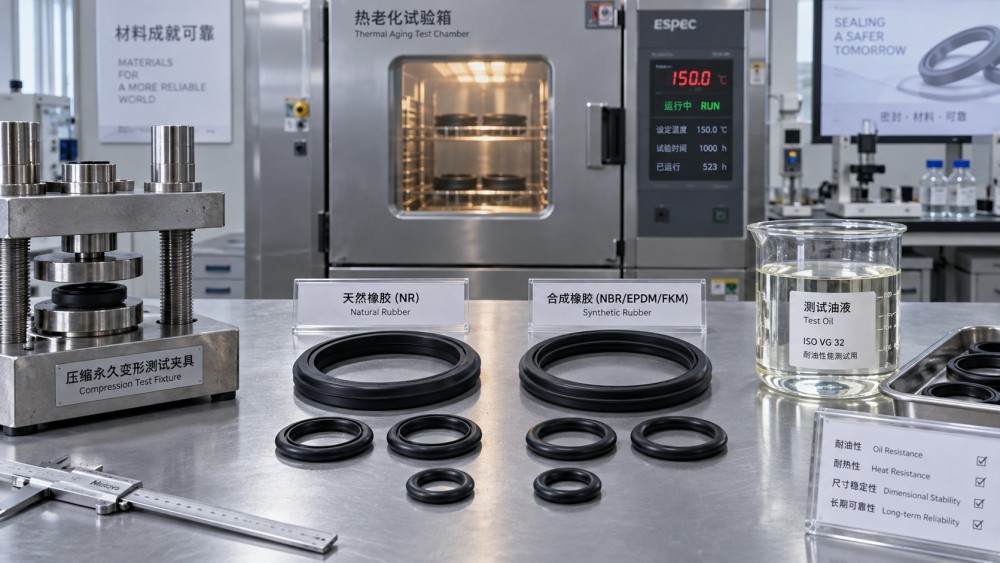
For mechanical applications without aggressive exposure, an NR/SBR or NR/BR blend may be worth investigating before a complete replacement. Blends can adjust processing and dynamic properties, but they do not automatically solve chemical incompatibility. A substantial natural rubber fraction can remain the limiting factor.
A material change is also a production change
A replacement compound with the same Shore hardness will not necessarily fill the same mold, shrink to the same dimensions, or produce the same sealing force. Hardness is only one property. Viscosity, stress relaxation, modulus, cure behavior, and filler loading all influence the finished component.
In injection molding, reassess flow behavior, pressure demand, scorch safety, venting, and cure time. In extrusion, examine dimensional stability, die swell, and the downstream curing arrangement. For bonded rubber-to-metal components, the adhesive system and surface preparation may need requalification as well.
Changing from a sulfur-cured formulation to a peroxide-cured one, where appropriate, can affect processing conditions and final properties. Some compounds also require post-curing. These are not details to resolve after committing to a production launch: they affect equipment capacity, energy use, work in progress, and delivery schedules.
This connection between material rheology and molding equipment is central to the perspective of the Global Polymer & Metal Molding Matrix (GPM-Matrix). Its coverage of rubber processing, manufacturing technology, and raw-material developments supports a useful discipline: assess a polymer substitution as a system decision, not an isolated purchasing decision.
Compare cost per accepted component and cost in service
The price per kilogram can mislead. Compound density changes material consumption by part volume. Cycle time, flash, scrap, post-curing, and inspection requirements change conversion cost. Tool modifications and customer approval work add transition costs that may be significant for low-volume products.
The relevant comparison has two layers. Factory economics concern the cost of producing an accepted component. Service economics concern replacement frequency, maintenance access, leakage consequences, and downtime. A costlier elastomer may be justified in a difficult-to-access seal, while offering little benefit in an inexpensive, lightly loaded indoor bumper.
Supply risk also deserves scrutiny, but synthetic does not automatically mean secure. Both natural and synthetic rubber supply chains can face disruptions and price volatility. Specialty synthetic grades may have fewer qualified sources or longer replenishment times. Check whether a second source supplies an approved equivalent compound—not merely a polymer with the same generic name.
Validate the replacement under combined operating conditions
A credible validation plan begins with measurable acceptance criteria. Define the fluid, temperature profile, mechanical loading, exposure duration, dimensional tolerances, and allowable property changes before testing. Without those limits, teams can collect extensive laboratory data and still disagree about whether the replacement passes.
Recognized methods can structure the work: ASTM D471 addresses the effect of liquids on rubber; ASTM D395 covers compression set; ASTM D573 addresses deterioration in an air oven; and ASTM D1149 addresses ozone cracking under controlled conditions. Confirm the applicable version and test conditions against customer requirements. These methods provide evidence, not universal approval for every application.
Separate tests are only part of the picture. A gasket may retain tensile strength after aging yet lose sealing force in service. Where practical, test actual components under combined heat, fluid contact, compression, or cyclic loading. Include installation and assembly effects, especially where stretching or metal contact creates local stress.
Run production trials using representative equipment and multiple batches. Verify dimensional consistency, cure repeatability, scrap behavior, and downstream assembly. For regulated or customer-controlled applications, confirm documentation and approval obligations before substitution. Compliance depends on the finished formulation and its intended use, not simply on selecting a named elastomer.
Keep natural rubber when the evidence supports it
If a natural rubber component meets its service-life target, operates without incompatible exposure, and runs consistently through production, retaining it can be the sound engineering choice. Better mixing control, revised protection against aging, or a geometry change may address the remaining weakness more economically than replacing the polymer.
Environmental claims need the same discipline. Natural rubber’s renewable origin does not by itself establish a lower lifecycle impact, while synthetic rubber’s durability does not automatically offset its production footprint. Compare sourcing, processing energy, reject rates, service life, and realistic end-of-life routes. Crosslinked rubber is not generally remeltable like a thermoplastic; recycled-content proposals therefore require performance validation.
The decision is ready when the replacement solves a documented limitation, remains manufacturable at acceptable cost, and passes the required validation. Before authorizing the switch, agree on a service-condition specification, a production-trial plan, qualified supply options, and customer acceptance criteria. If those are still unclear, selecting a synthetic grade is premature.
Related News
- 00
0000-00
How to compare molding equipment for high-volume production - 00
0000-00
EU Tightens Food-Contact Recycled PET Import Controls and Adds Customs Code - 00
0000-00
How to size vulcanizing equipment for rubber hoses - 00
0000-00
Is natural rubber more price volatile than synthetic rubber? - 00
0000-00
EU Tightens Import Controls and Traceability for Food-Contact Recycled PET