


Global Injection Molding Trends: Automation, Energy Costs, and Capacity Shifts
Global Injection Molding Trends: Automation, Energy Costs, and Capacity Shifts
Automation, energy costs, and shifting production capacity are reshaping the economics of injection molding—and the decisions facing manufacturers, equipment suppliers, and investors. For business leaders, the challenge is knowing where automation delivers measurable returns, how power prices affect plant competitiveness, and when regional capacity shifts warrant a sourcing or investment response. GPM-Matrix’s global injection molding insights connect these forces with practical priorities: equipment selection, operational resilience, and resource efficiency. This article examines how automation strategies, energy management, and changing manufacturing footprints can inform more resilient investment and sourcing decisions.
These forces should not be evaluated separately. A lower-cost production location may lose its advantage if electricity supply is unreliable or tooling support is distant. A highly automated plant may struggle economically if its product mix changes frequently. And a new press can reduce machine-level electricity consumption without resolving inefficient drying, cooling, or compressed-air systems.
The useful unit of comparison is therefore not the machine, the wage rate, or the country. It is the cost and reliability of delivering an accepted part to the customer.
Automation is moving beyond part removal—but returns remain application-specific
Injection molding automation spans much more than robots unloading presses. It can include insert placement, in-mold labeling, vision inspection, assembly, packing, material handling, and production-data collection. The business case becomes stronger when these functions address a documented constraint rather than simply reduce the number of people standing beside a machine.
Consider a cell producing components that require inserts and downstream inspection. Automating unloading alone may leave the real bottleneck untouched. Integrating insert loading and inspection could improve throughput, but only if positioning accuracy, inspection reliability, and reject handling are robust. Otherwise, the cell produces parts faster while creating more downtime or moving quality problems downstream.
For stable, high-volume programs, dedicated automation can be justified by repeatable cycles and predictable utilization. For short runs and frequent mold changes, flexibility matters more: standardized interfaces, reusable grippers, accessible programming, and quick changeovers may outweigh maximum cycle speed.
A credible investment review should distinguish between labor eliminated, labor redeployed, and additional technical labor required. Robot maintenance, controls troubleshooting, and inspection-system calibration do not disappear after commissioning. Neither do spare-parts costs or the production losses associated with an integrated cell stopping as a whole.
Process stability comes before autonomous optimization
Connected sensors and Industrial Internet of Things systems can make process drift and equipment condition more visible. Yet a dashboard is not a corrective action. Predictive maintenance requires reliable signals, useful failure history, and a maintenance team able to respond. Where those foundations are missing, condition monitoring and disciplined preventive maintenance may be the more practical starting point.
The same caution applies to closed-loop process adjustment. Melt temperature, resin moisture, cavity pressure, and cooling conditions affect part quality differently across applications. Control limits must be established through process validation, not copied from another mold. For regulated products, changes may also require documented review or requalification.
The strongest automation strategy is often selective: automate the repetitive or quality-sensitive steps, retain flexibility where product variation is high, and build the technical capability to keep the cell running.
Energy competitiveness depends on the whole production cell
Power prices change the economics of injection molding, but tariff comparisons alone are insufficient. Plants may face time-of-use pricing, demand charges, contract conditions, or supply interruptions. Two facilities paying similar average rates can still have different electricity bills because their peak demand and operating schedules differ.
Machine architecture matters. All-electric presses can offer energy and control advantages in suitable applications, while servo-hydraulic and hybrid systems may fit different force, size, and process requirements. No configuration should be selected on a technology label alone. Compare performance using the intended resin, mold, cycle, and quality criteria.
The measurement boundary matters just as much. A press-only reading excludes dryers, chillers, temperature-control units, conveyors, robots, and compressed air. Those loads can materially affect the economics of the finished part. Central utility consumption must also be allocated consistently when comparing production lines.
A useful cell-level view follows material from drying and feeding through molding, cooling, inspection, and packing, showing both energy inputs and rejected output.
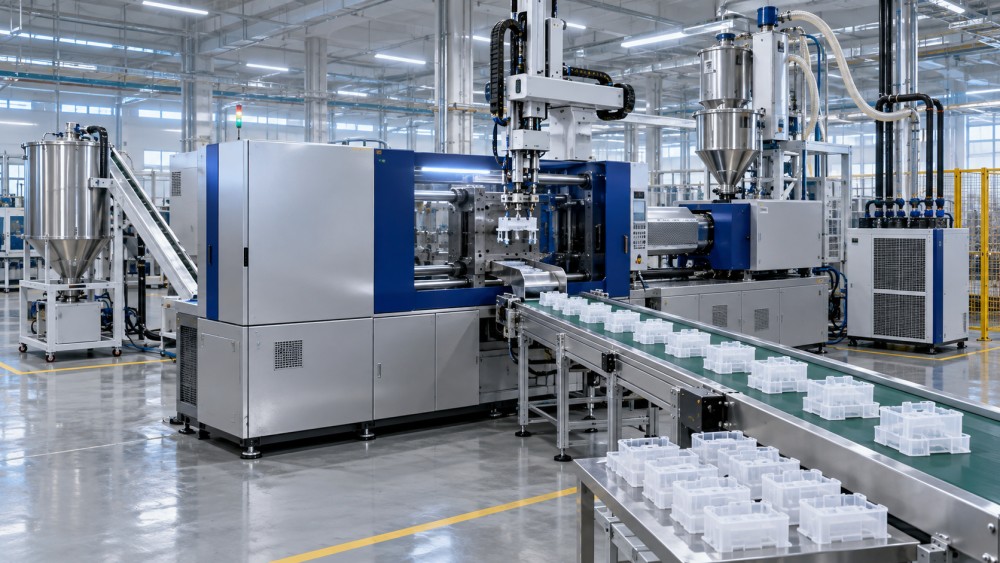
Energy intensity should be measured against accepted output. Electricity per kilogram processed can help with internal comparisons, but electricity per accepted part is often more relevant to a customer program. A lower-consumption cycle is not an improvement if it increases rejects or compromises dimensional stability.
Before replacing equipment, investigate avoidable loads: machines idling between jobs, compressed-air leaks, unnecessary drying time, poor insulation, and cooling systems operating outside actual process needs. Adjustments must respect material specifications and validated process windows. Reducing drying or cooling indiscriminately can cost more in scrap than it saves in electricity.
Energy and carbon performance also need separate treatment. Lower electricity consumption generally reduces operating exposure, but emissions depend on the electricity source and accounting boundary. Customer reporting requirements and local rules should be checked rather than inferred from a machine’s efficiency claims.
Capacity shifts are selective, not a simple migration to cheaper regions
Nearshoring and regional sourcing attract attention because transport disruption, inventory exposure, and customer proximity affect delivered cost. Still, injection molding capacity is not interchangeable. A plant with available clamping tonnage may lack the mold technology, resin-handling capability, metrology, or quality systems needed for a specific program.
North American sourcing reviews may compare domestic production with Mexican manufacturing options. European buyers may weigh nearby production against imported components. Asian supply-chain strategies may involve established Chinese operations alongside alternatives in Southeast Asia or India. These are potential sourcing pathways, not evidence that one region is universally gaining or losing suitable capacity.
Within each region, industrial infrastructure can matter more than national averages. Access to toolmakers, machine service engineers, resin distribution, stable utilities, and transport links affects both launch speed and recovery from problems. A favorable labor rate cannot compensate indefinitely for a mold repair that requires overseas shipment.
Moving an existing mold also does not guarantee immediate production continuity. The receiving press must accommodate its dimensions, tie-bar spacing, injection requirements, and interfaces. Cooling connections, hot-runner controls, robot access, and ancillary equipment need checking. Trial production and customer approval may remain necessary even when the tool itself is unchanged.
For sourcing decisions, request evidence of usable capacity rather than a list of installed machines:
- Production availability: committed schedules, maintenance windows, and realistic room for demand changes.
- Technical fit: shot size, injection capability, mold compatibility, material handling, and process control.
- Launch readiness: tooling support, trial capacity, inspection resources, and approval responsibilities.
- Continuity: backup equipment, critical spares, utility reliability, and alternative material arrangements.
Dual sourcing can reduce dependence on one site, but it adds qualification and coordination costs. It works best when tooling ownership, process documentation, material specifications, and change-control responsibilities are clear before disruption occurs.
Demand quality matters more than headline market growth
Aggregate injection molding forecasts can conceal very different investment requirements. Automotive parts, home-appliance components, and medical packaging do not create equivalent demand for machines or production services. Program duration, dimensional tolerances, cosmetic requirements, traceability, and approval cycles determine which capacity is commercially useful.
Electrification changes automotive component requirements, but it does not translate automatically into more demand for every molded product. Buyers should examine specific applications and material choices. Likewise, metal giga-casting and polymer injection molding belong to different processes; their relevance to lightweight manufacturing should not be mistaken for direct market equivalence.
Recycled-material requirements introduce another layer of differentiation. Variability in viscosity, moisture, contamination, and color can complicate processing, depending on feedstock quality and application. Equipment controls may help manage variation, but they cannot replace incoming-material checks or make an unsuitable resin acceptable. Biodegradable polymers also require material-specific assessment rather than assumptions based on their environmental positioning.
For equipment suppliers, this points toward application-specific capability rather than broad capacity claims. For investors, it means testing whether projected demand matches the assets being financed—and whether those assets remain useful if the initial customer program changes.
Turn market intelligence into a decision that survives uncertainty
A practical investment model should combine utilization, accepted-part yield, energy use, staffing, maintenance, tooling, logistics, and working capital. Test the result under lower volumes, higher power costs, delayed approvals, and longer recovery times. Automation that pays back only at uninterrupted full utilization deserves closer scrutiny.
GPM-Matrix’s role as an intelligence portal across injection molding, die-casting, extrusion, and rubber processing is to connect material behavior with equipment and market economics. Its Strategic Intelligence Center brings polymer-processing, metallurgy, and industrial-economic perspectives to questions that cannot be answered by machine specifications alone. Sector news, evolutionary trends, and commercial insights are most useful when they inform a defined sourcing or capital decision.
Effective global injection molding insights should separate observed developments from forecasts and identify which local assumptions still need verification. A raw-material price movement, carbon-policy announcement, or equipment order trend may be relevant, but none independently proves that a plant expansion is justified.
Before approving the next project, establish a baseline from representative production, confirm the receiving site’s technical and delivery capabilities, and stress-test delivered cost. The decisive question is not whether a facility is more automated, newer, or geographically closer. It is whether it can deliver the required quality and volume at an acceptable cost when operating conditions change.
Related News
- 00
0000-00
How to compare molding equipment for high-volume production - 00
0000-00
EU Tightens Food-Contact Recycled PET Import Controls and Adds Customs Code - 00
0000-00
How to size vulcanizing equipment for rubber hoses - 00
0000-00
Is natural rubber more price volatile than synthetic rubber? - 00
0000-00
EU Tightens Import Controls and Traceability for Food-Contact Recycled PET