




Which Packaging Materials Are Easiest to Recycle?
Aluminum cans, steel cans, clear glass bottles and jars, uncoated paperboard, PET bottles, and HDPE containers are often among the easiest packaging formats to recycle. Their advantage is not simply that the base material is recyclable. They are widely recognized by sorting systems, commonly collected, and supported by established markets for recovered material. A package becomes harder to recycle when it combines incompatible layers, uses dark or heavily pigmented resin, carries persistent contamination, or is too small for sorting equipment to capture.
The practical question is therefore not, “Can this material be recycled somewhere?” It is whether the package can move through the local collection, sorting, cleaning, and remanufacturing chain without losing too much material quality. A technically recyclable pouch or molded article can still have a poor recovery outcome if it is not accepted in household collection or cannot be separated reliably at a material recovery facility.
Materials with the strongest recycling pathways
Aluminum is one of the most robust packaging materials in a circular system. Beverage cans, trays, and certain closures have high value as scrap, and aluminum can be remelted repeatedly without the same type of polymer-chain degradation seen in plastics. Clean, single-material aluminum is straightforward to identify and separate from mixed waste using eddy-current equipment. Thin foil presents a different issue: loose foil can be missed by screens and sorting equipment, while foil bonded to paper or plastic is no longer a simple metal package.
Steel, including tin-plated steel food cans, also performs well where collection systems accept metal packaging. Magnets make steel comparatively easy to recover from mixed waste. Labels and coatings are normal parts of the recycling stream, but a steel can should be reasonably empty and free from excessive food residue. A can with a plastic fitment, a complex dispensing valve, or a large nonmetal component needs more attention because the added parts can interfere with processing or reduce the quality of recovered steel.
Glass bottles and jars can be recycled into new containers or other glass products when they are collected and sorted by color. Glass does not lose its basic material properties through remelting, but it is heavy, fragile, and expensive to transport relative to its weight. The biggest quality problem is contamination by ceramics, stones, heat-resistant glass, or other non-container glass. These materials can survive furnace temperatures differently and create defects in new glass. Color also matters: clear, green, and amber glass are commonly separated because mixed colors limit the applications for cullet.
Paper and paperboard are easy to recycle when they are dry, mostly fiber-based, and free of coatings that resist pulping. Corrugated board, paper bags, cartons without complex barrier layers, and uncoated folding cartons fit this profile. Fibers shorten each time paper is recycled, so recovered fiber is often blended with virgin or longer recycled fiber for demanding applications. Grease, food residue, wax, plastic films, and metallic laminations reduce the usefulness of a paper package. A clean cardboard box and a grease-saturated food box may look similar, yet their recycling prospects are very different.
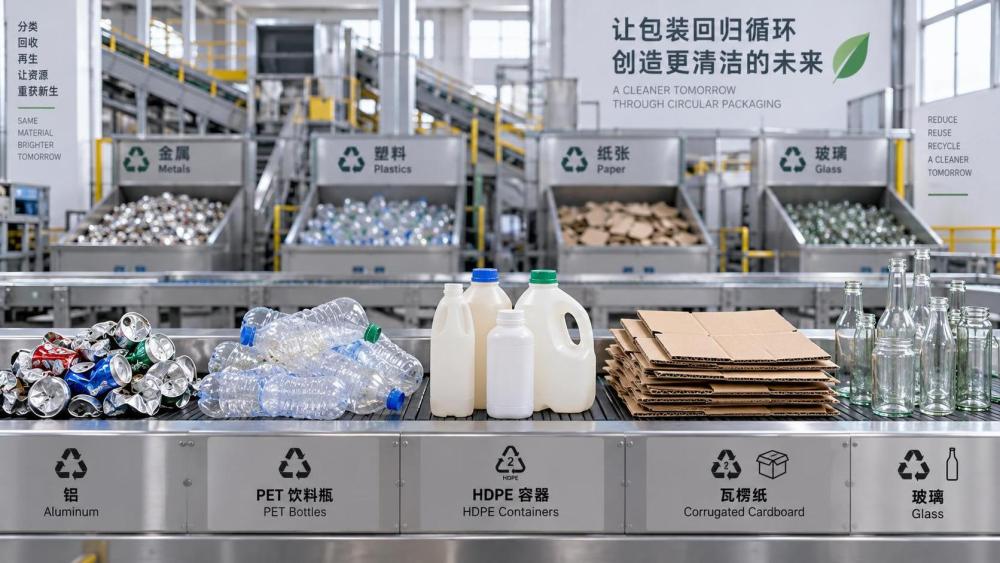
PET, identified in many systems as resin code 1, is a widely recognized packaging plastic. Clear PET beverage bottles are especially compatible with existing collection and reprocessing routes because they can be sorted optically, washed, ground into flakes, and converted into new packaging or other products when material quality is controlled. Colored PET, opaque PET, multilayer PET, full-body shrink sleeves, and residues from oils or sauces create extra sorting and washing demands. The resin is still PET, but the package design can make its path through the system much less reliable.
HDPE, often marked as resin code 2, is another strong candidate. Milk bottles, detergent containers, personal-care bottles, and many rigid household containers are made from HDPE. Natural, unpigmented HDPE and common light-colored grades generally provide better recovery options than black or heavily colored formats. Near-infrared sorting equipment identifies many plastic resins by reflected light; carbon-black packaging has historically been difficult for some equipment to detect. Detection technology is improving, but package color should not be selected on the assumption that every facility can recover it equally well.
Why a recyclable material can become a difficult package
Packaging is rarely made from a base material alone. It may include pigments, barrier coatings, adhesives, labels, closures, inks, absorbent pads, tamper bands, and product residues. Each addition has a functional purpose, but it can change the recovery outcome. The easiest package is usually one that performs its protection function with the fewest incompatible material families.
Flexible packaging illustrates the problem clearly. A snack pouch made from a film laminate may combine polyethylene for sealing, polyester for stiffness, aluminum for barrier performance, and printing layers for appearance. The laminate is effective at protecting food, yet the thin bonded layers are difficult to separate at commercial scale. Mechanical recycling generally needs a relatively consistent polymer stream. When several polymers are permanently laminated together, the recovered material may have unpredictable melt behavior and limited end uses.
Multilayer structures are not automatically unsuitable. They may prevent food spoilage, reduce product loss, or enable a lower overall material weight. The relevant comparison is between the package's full function and the recovery route actually available. Where a mono-material polyethylene or polypropylene structure can meet shelf-life, sealing, and puncture requirements, it often offers a clearer recycling pathway than a mixed laminate. Where an oxygen or moisture barrier is indispensable, designers need to assess whether the barrier layer is compatible with the intended recycling stream and whether its proportion remains manageable.
Labels and sleeves deserve separate scrutiny. A small paper label on a glass bottle may be removed during washing, whereas a full-body plastic sleeve can hide the container from optical sorting equipment. A PET bottle covered in an opaque sleeve may be rejected or sorted incorrectly if the sleeve is not perforated or designed for easy removal. Likewise, a pressure-sensitive adhesive that remains tacky during washing can form sticky contaminants in recovered paper or plastic. These issues are often missed because the label represents only a small share of package weight, while its effect on sorting can be large.
A useful way to compare packaging choices
This comparison should be read as a design and disposal guide rather than a universal acceptance list. Collection rules differ by location, and the same PET tray or paper carton can be accepted in one area and excluded in another. The physical recyclability of a material and the operational recyclability of a package are related but separate questions.
Material purity matters before and after collection
Purity begins with package construction. A mono-material container gives sorters and recyclers a more predictable feedstock. For rigid plastic packaging, keeping the body, label, closure, and tamper feature within compatible polymer families can simplify the process. Compatibility does not require every component to be identical, but components should either separate cleanly during reprocessing or remain in the stream without causing unacceptable defects.
For example, a recyclable bottle body can lose value when a closure sinks or floats in the wrong wash fraction, or when the label creates colored fragments that contaminate a clear recycled stream. Density, melting range, and behavior in caustic washing are practical details that shape the result. A component that is harmless in a molding trial can become troublesome after shredding because it is dispersed through thousands of flakes.
Contamination from the filled product is equally important. Rinsing a container does not need to make it spotless, but substantial liquid, food, oil, paint, or chemical residue can create handling problems. Greasy paper fibers cannot always be recovered effectively. Residual oils and fragrances can persist through a plastic washing line. Containers used for hazardous substances must follow the applicable local disposal route rather than being placed in ordinary recycling collection.
Common signals that mislead package selection
A resin identification code is not a recycling instruction. The symbol identifies the resin family, but does not confirm that local collection accepts the item, that sorters can capture its size and color, or that a recycler will buy the material. This is particularly relevant for resin codes used on less common plastics, bioplastics, and mixed-material products.
“Compostable” is also different from recyclable. Compostable packaging is designed for an organic treatment route under defined conditions; it can contaminate conventional plastic recycling if it enters the wrong stream. Conversely, a recyclable plastic is not necessarily suitable for composting. The disposal claim must match the collection and treatment system available where the package is used.
Lightweighting can reduce material use, but a lighter package is not automatically easier to recycle. Very thin films, small caps, tear strips, and miniature sachets can fall through screens or become trapped in sorting equipment. A larger rigid container made from a recognized material may have a stronger recovery pathway even if it uses more material per unit than a lightweight flexible alternative. The right assessment considers product protection, material mass, collection behavior, and the quality of the recovered output together.
Design choices that improve real-world recovery
Start with the recycling stream the package is intended to enter. If it will be collected with bottles and rigid containers, select a resin and form factor that local sorters already recognize. If it is intended for paper recovery, avoid unnecessary plastic or wax barriers and use coatings that can be managed in pulping. Metal and glass packaging benefit from minimizing attached materials that do not belong in their primary stream.
- Prefer clear or lightly colored PET when visual requirements permit. Clear recycled PET has broader potential uses than material contaminated by dark colors or opaque additives.
- Use detachable sleeves, labels, pumps, or dispensing components where a non-compatible part is necessary. Separation must be obvious and practical; a component that requires tools or detailed instructions is less likely to be removed.
- Keep different materials visibly distinct. A paper label, a plastic bottle, and a metal closure are easier to separate when the assembly does not conceal one material inside another.
- Specify recycled-content requirements alongside processing requirements. Recycled resin can have different color, odor, melt-flow, moisture, or contamination characteristics, so mold design, drying practice, and process settings need to reflect the actual feedstock.
For molded and extruded packaging, recycled content should be evaluated in the intended conversion process rather than treated as a simple substitution. Recycled polymer may have a wider property range than virgin material. Thin-wall molding, transparent parts, high-gloss surfaces, and tight sealing surfaces can be more sensitive to variation. Drying, filtration, melt temperature, residence time, screw design, and regrind ratio all influence whether recycled feedstock performs consistently. These production constraints do not argue against recyclable packaging; they show why package design and material processing need to be considered together.
The easiest packaging materials to recycle are those that stay recognizable from disposal through remanufacturing. Clean aluminum and steel, color-sorted glass, dry paper fiber, clear PET, and common HDPE formats generally have the clearest path. Keeping the package simple, separating unavoidable mixed components, and matching the design to actual collection infrastructure preserve that advantage.
Related News
- 00
0000-00
When does multilayer film extrusion for packaging improve barrier performance? - 00
0000-00
How giga-casting innovations are improving aluminum part design - 00
0000-00
How to choose a laboratory rubber mixing mill for small-batch compounds - 00
0000-00
Technical comparison guide for choosing all-electric molding machines - 00
0000-00
How to verify compliance with plastics carbon standards